
Find Florida Released Inmates
The Florida Department of Corrections keeps track of released inmates through its online search tools. You can look up people who have been let go from state prisons or are set for release soon. The state database gets updated every night for release dates and location changes. County jails across Florida also hold records of local inmates who have been released. Each of the 67 counties runs its own system for tracking jail releases. State prison records and county jail records are separate, so you may need to search more than one place to find the person you want.
Florida Released Inmates Quick Facts
Florida Department of Corrections Inmate Search
The Florida Department of Corrections runs the main state database for finding released inmates. This system covers all felony offenders who were sent to state prison or state supervision. It does not include people held in county jails or on county probation. The database has several search options that work together to help you find inmate records across Florida.
One central search portal lets you look through all offender databases at once. You can search inmate population records, inmate release information, escape data, supervised offenders, and absconder lists all from the same place. The Inmate Release Information Search gets updated every night, so you see current data on who has been released or is scheduled for release soon. This search shows both people who have already left custody and those with a future release date set by the state of Florida.
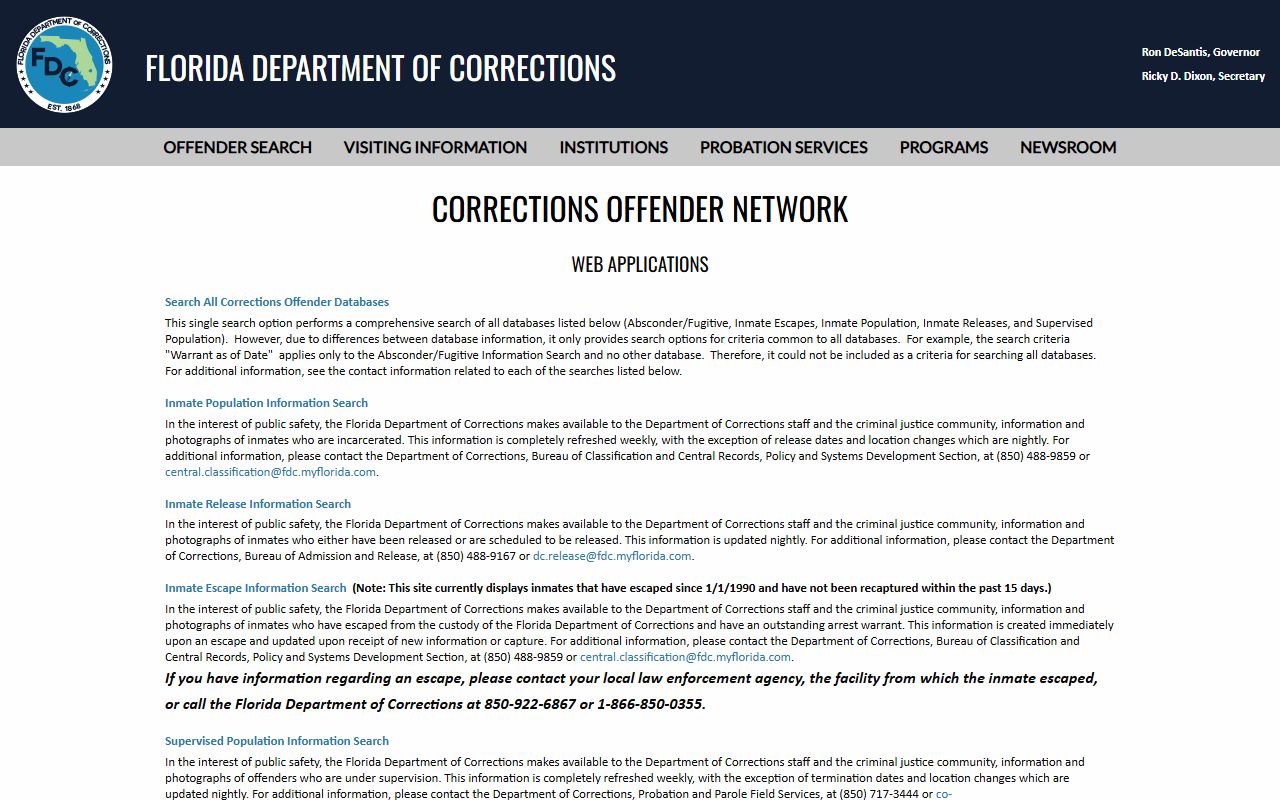
The main portal is at pubapps.fdc.myflorida.com/OffenderSearch/InmateInfoMenu.aspx, where you can start any type of search. For release information only, use the dedicated release search tool. When you search by name, the system finds all records that start with the letters you type. If you enter "Will" it returns Williams, Willis, Williamson, and other matches. This helps when you are not sure of the exact spelling. You can also search by DC number, which is a six-character ID assigned by the department to each offender in Florida.
The state database information comes from court records given to the Florida Department of Corrections. The department warns that it does not guarantee the data is completely accurate or up to date. If you think information is wrong, contact the Bureau of Classification and Central Records at (850) 488-9859. For questions about release dates or release status, call the Bureau of Admission and Release at (850) 488-9167 or email dc.release@fdc.myflorida.com.
How to Search for Released Inmates in Florida
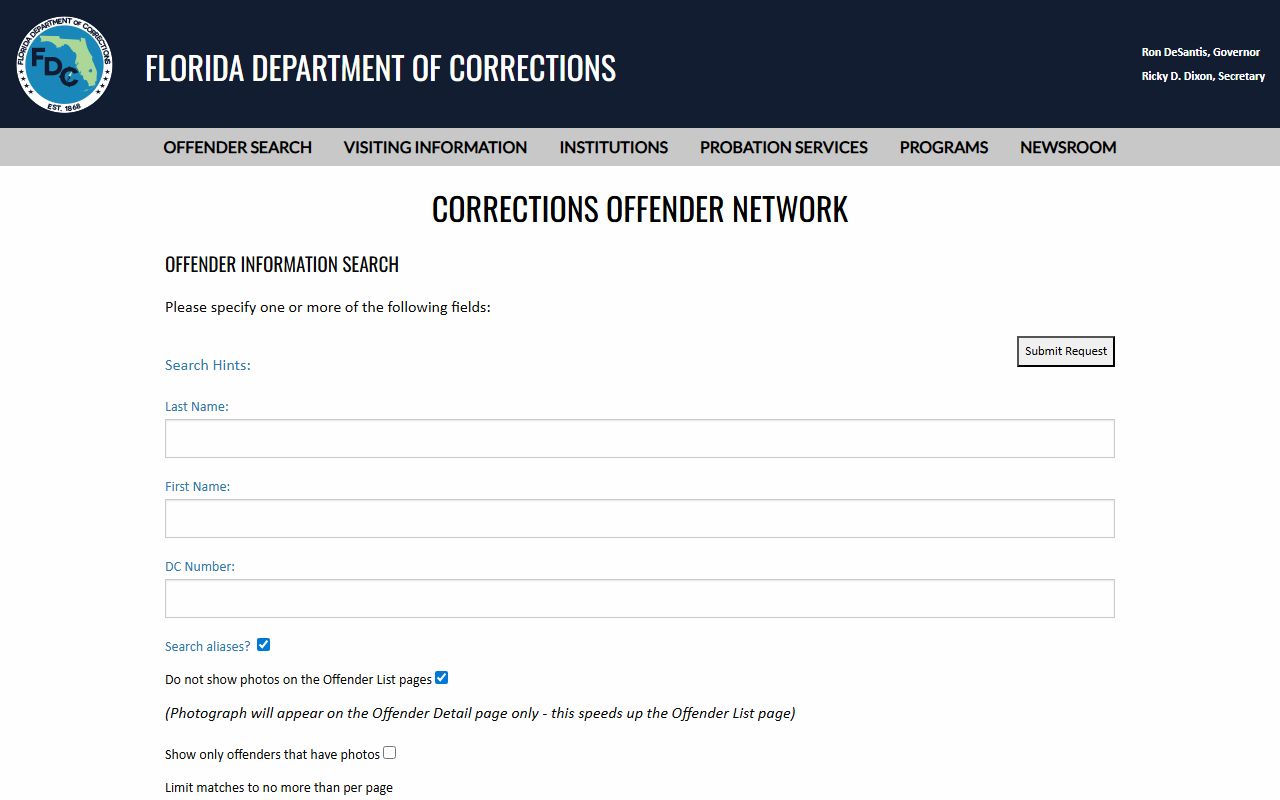
You need at least a first or last name to start a search. The more details you have, the better your results will be. Full names work best. Birth dates help narrow down matches when a name is common. The DC number gives you an exact match if you have it.
When you search by name, check the "search aliases" box if you want to look through all known names for that person. If you leave this unchecked, the system only checks the name used when the person was committed to custody. Many inmates have aliases on file, so using this option can help you find the right record in Florida.
The Inmate Population Information Search shows people currently in state prison. This database refreshes completely each week. Release dates and location changes update every night. If someone was just booked, they may not appear until the next update cycle runs. The Inmate Release Information Search updates nightly and includes both past releases and future scheduled releases for inmates in Florida custody.
Note: County jail inmates do not appear in state searches, so check with the local sheriff if the person was held at a county facility.
Reaching the Florida Department of Corrections
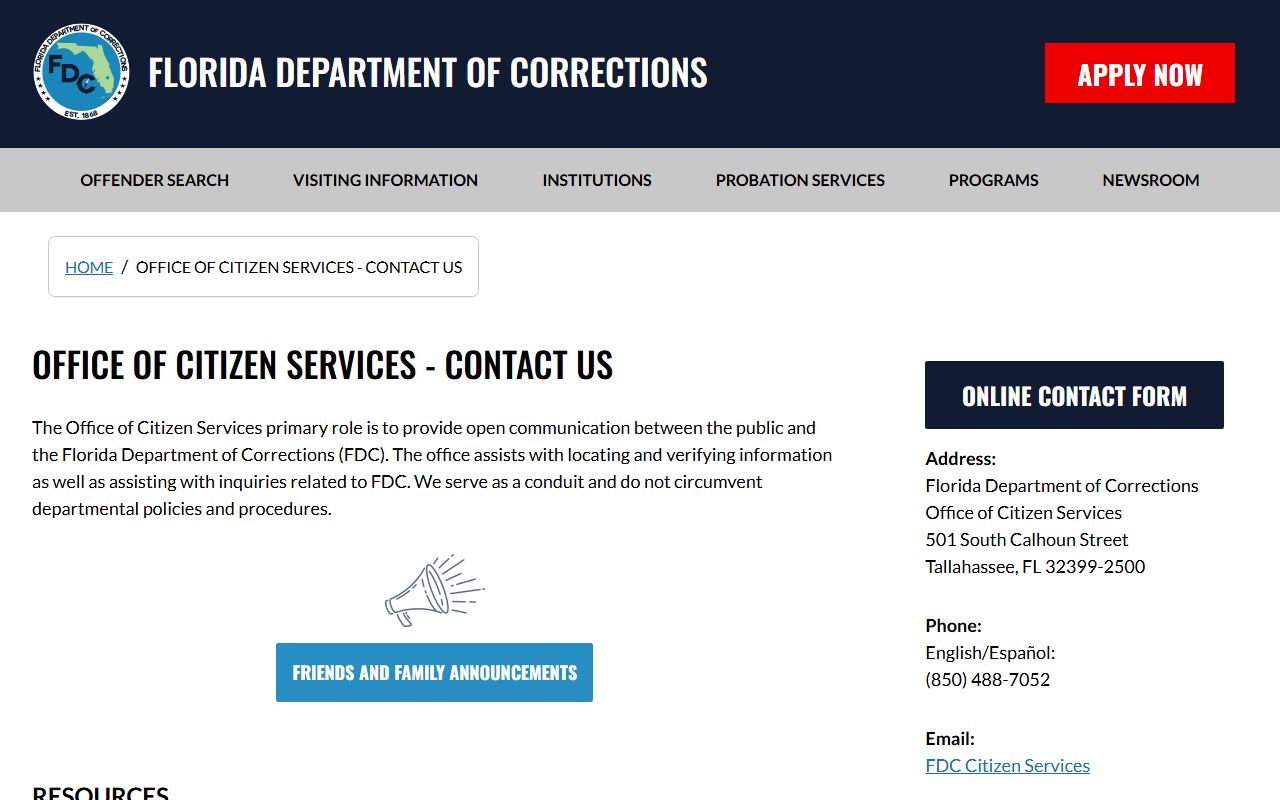
The main FDC office is at 501 South Calhoun Street in Tallahassee, Florida 32399-2500. The main phone line is (850) 488-7052. Different bureaus handle different types of requests, so calling the right office saves time and gets you answers faster.
For questions about inmate populations or escapes, contact the Bureau of Classification and Central Records at (850) 488-9859 or email central.classification@fdc.myflorida.com. For inmate release dates and release information, reach the Bureau of Admission and Release at (850) 488-9167 or email dc.release@fdc.myflorida.com. Probation and parole questions go to Field Services at (850) 717-3444 or email co-supervision@fdc.myflorida.com. The Absconder Unit tracks offenders who stopped reporting for supervision. Call (850) 717-3475 on weekdays from 8:00 AM to 5:00 PM.
The Office of Citizen Services helps the public with general questions. Call (850) 488-7052 for English or Spanish help. You can also submit questions through an online form at share.hsforms.com. Press inquiries should go to the Communications Office at (850) 488-0420 or email PublicAffairs@fdc.myflorida.com.
Requesting Inmate Records from Florida DOC
Public records requests follow Chapter 119 and Section 945.10 of Florida Statutes. The FDC reviews all records for confidential or exempt information before releasing them. Medical records, mental health files, and substance abuse records are confidential under Section 945.10. Protected health information, preplea reports, presentence investigations, and witness protection data cannot be disclosed to the public in Florida.
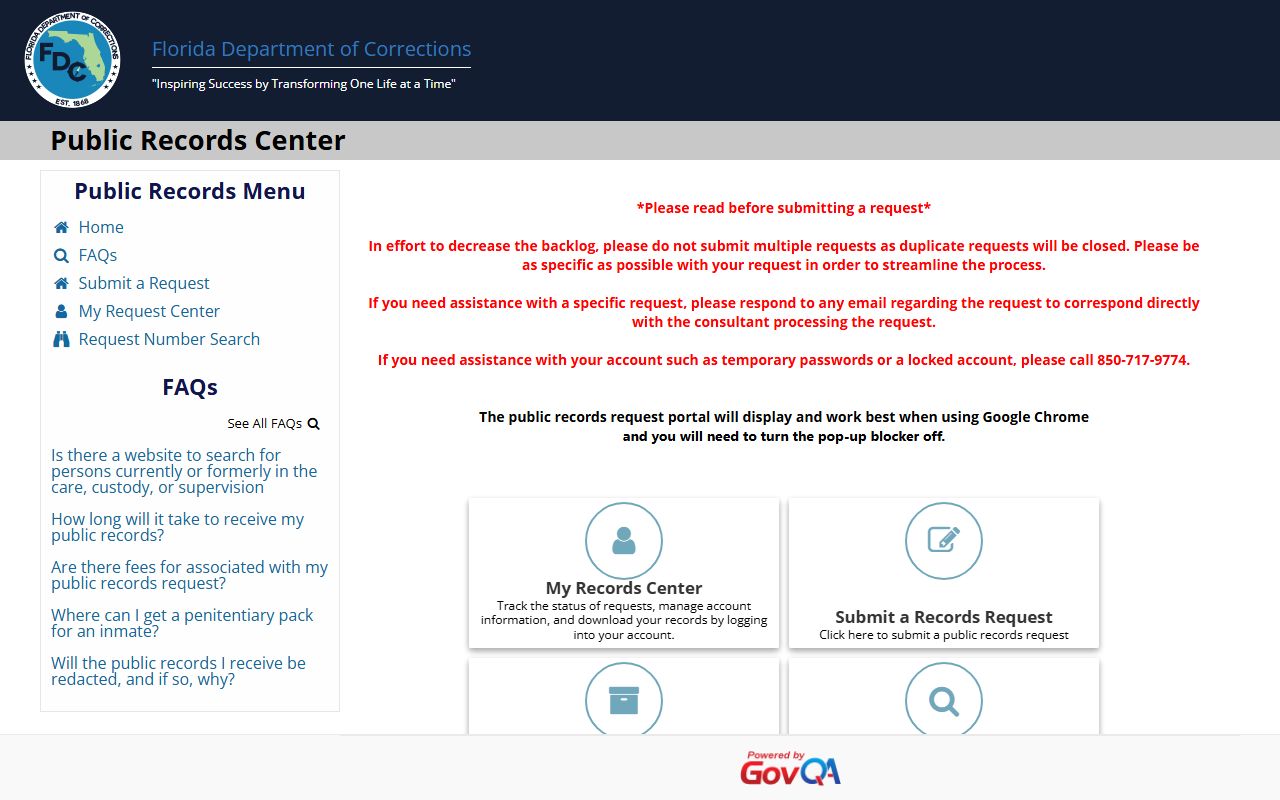
To request records, use the online portal at floridadoc.govqa.us or contact James Best, the public records custodian, at the Department of Corrections, 501 S. Calhoun Street, Tallahassee, FL 32399. Call (850) 717-9774 or fax to (850) 488-4534. The department provides cost estimates for producing records. Greater specificity in your request can lower costs. Payment is required before records are prepared and released.
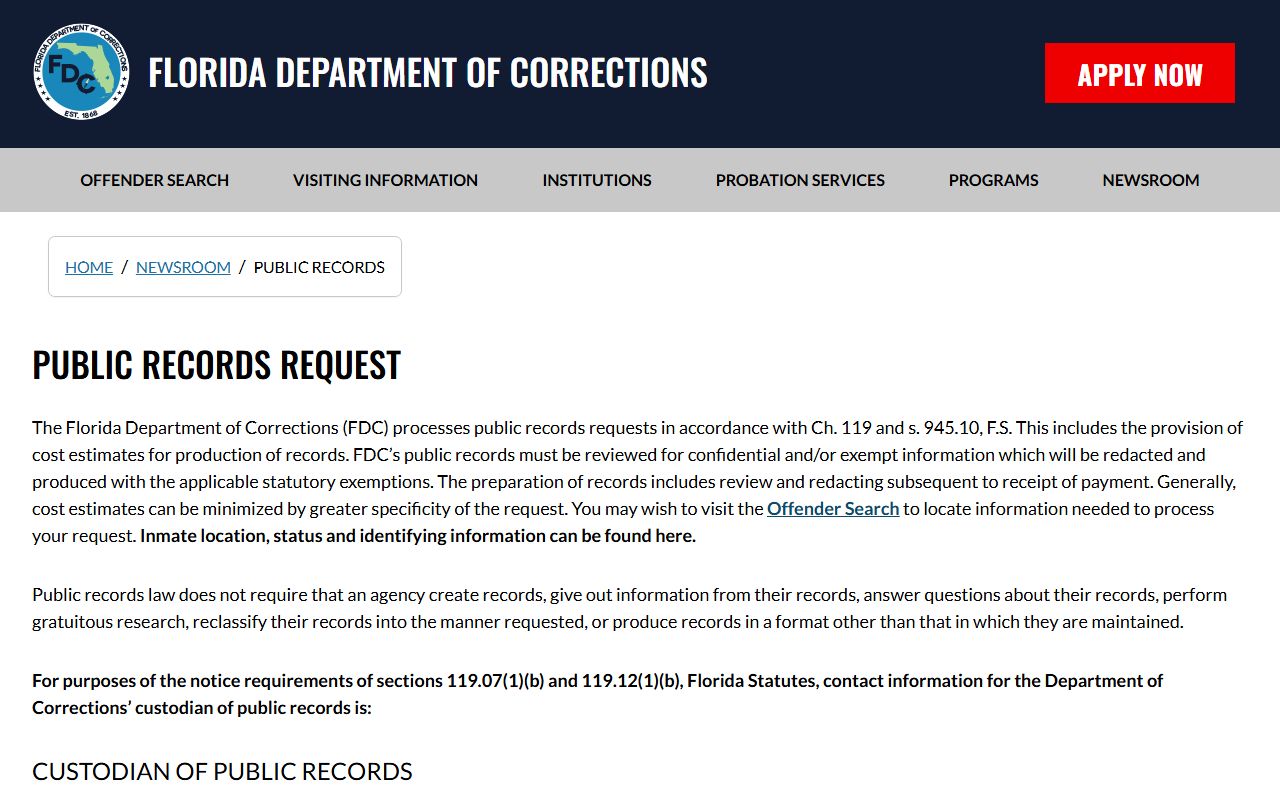
Medical records requests must include a signed release form. Use form DC4-711B for English or DC4-711B-Spanish for Spanish. These forms are available at fdc-media.ccplatform.net. Without a properly executed release, all health information will be redacted from the records you receive. Education records also require a signed consent form, DC5-165, available at fdcweb.fdc.myflorida.com. Section 1002.22 and Section 1002.221 of Florida Statutes make education records confidential.
Subpoenas directed to the Department of Corrections should not be filed as public records requests. Serve subpoenas on the department or staff according to Florida Statutes and the Florida and Federal Rules of Civil Procedure. Public records law does not require agencies to create new records, answer questions about records, perform research, or produce records in a format different from how they are kept.
Florida Laws on Inmate Records
Chapter 119 of the Florida Statutes is the Public Records Act. It governs access to all public records, including inmate information held by the Department of Corrections and county jails. This law applies to virtually all state and local government units created by statute or the Florida Constitution. In the absence of a specific exemption, prison and inmate records must be disclosed under the Public Records Act. The law even applies to private companies that run county jails under contract in Florida.
Section 945.10 of the Florida Statutes lists what inmate records are confidential and exempt from public disclosure. Medical, mental health, and substance abuse records cannot be released without consent. Protected health information of inmates is also exempt. Preplea, pretrial intervention, presentence, and postsentence investigative records are confidential. Information about people in witness protection programs stays secret. Victim statements and victim identities are protected. Records that could jeopardize a person's safety are exempt. Information about executioners and anyone involved in lethal injections is confidential.
Section 119.07 governs inspection and copying of records. Agencies can charge for supervision services when someone wants to photograph records. Special service charges apply when requests require extensive use of technology resources or staff time. An agency cannot refuse to allow inspection based on the number of records requested or the time span covered by the request. However, agencies can provide cost estimates and require payment before producing large volumes of records in Florida.
Juvenile offender records follow different rules under Section 985.04 of Florida Statutes. All information about juveniles obtained by courts, the Department of Corrections, the Florida Commission on Offender Review, law enforcement, or treatment providers is confidential and exempt from public disclosure. There are specific exceptions for law enforcement purposes and certain court proceedings, but in general, juvenile records are not available to the public.
Finding Released Inmates in County Jails
County jails in Florida operate separately from state prisons. Each county sheriff runs the local jail and maintains its own inmate records. When someone is arrested and booked into a county facility, that information goes into the county system. It does not appear in the state Department of Corrections database unless the person is later transferred to state custody after sentencing.
Most Florida counties offer online inmate search tools on their sheriff's office websites. These databases show current inmates and, in some cases, recent releases. Some counties keep release logs that list everyone released in the past few days or weeks. Other counties only show people currently in custody. You need to check with each individual county to see what release information they make available online.
Broward County provides both an arrest search portal and an inmate release log at releaselog.sheriff.org. The release log shows the date, booking number, last name, and first name of each person released from Broward County facilities. Hillsborough County has an arrest inquiry portal at webapps.hcso.tampa.fl.us/arrestinquiry that lists current inmates and booking information. Miami-Dade offers an inmate search at miamidade.gov/Apps/mdcr/inmateSearch for people in their corrections system. Orange County updates its inmate database every 30 minutes at netapps.ocfl.net/BestJail/Home/Inmates.
If you cannot find release information online, call the county jail directly. Many jails have a phone line for inmate information. Staff can tell you if someone is currently in custody and, in some cases, when they were released. Some counties require you to submit a formal public records request to get detailed release records or historical data.
Other Resources for Inmate Information in Florida
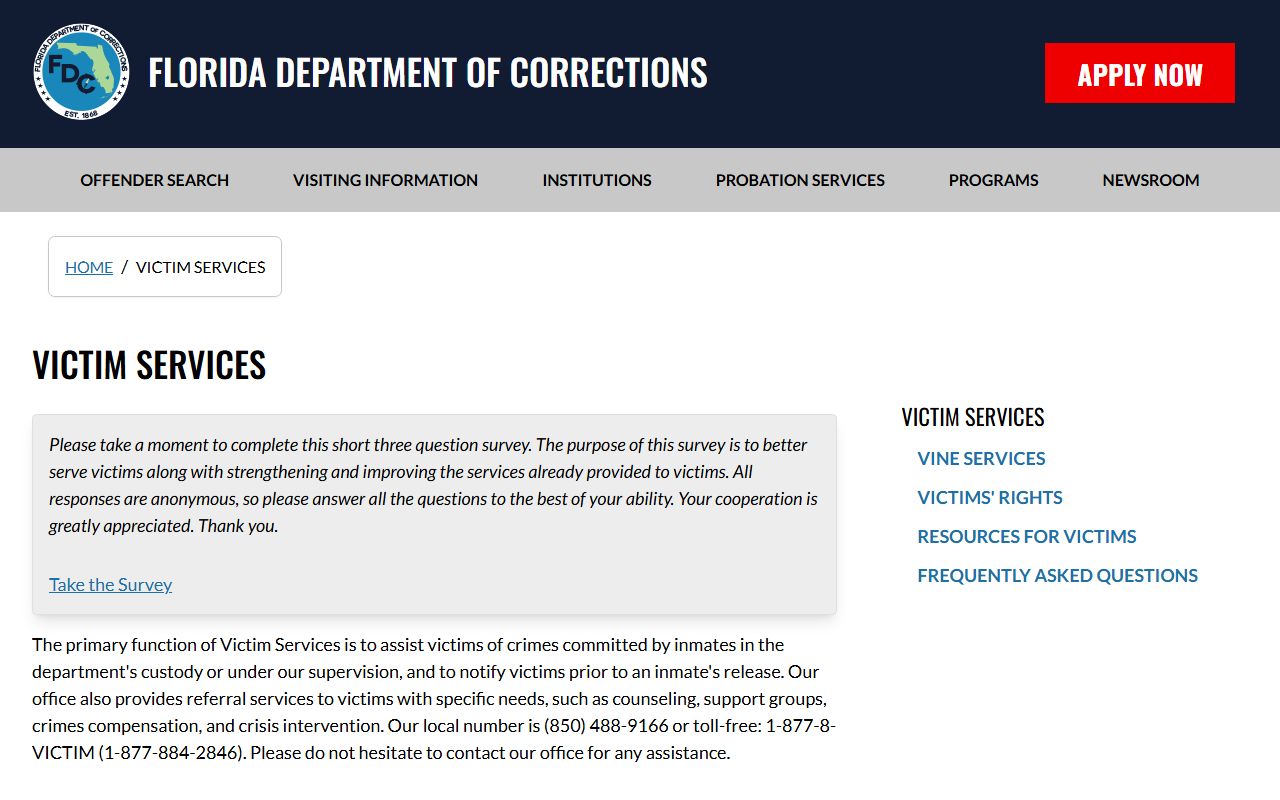
The FDC website at fdc.myflorida.com has links to institution directories, probation services, and victim services. The institutions directory lists all state prisons with addresses and contact information. Probation services information helps you understand how community supervision works in Florida. Victim services provide resources for people affected by crimes, including notification programs that alert victims when an offender is released.
For federal inmates, use the Federal Bureau of Prisons inmate locator. The BOP system is separate from Florida state records. Federal facilities in Florida include detention centers and prisons run by the U.S. government. Those inmates do not appear in state databases. Juvenile records are handled by the Florida Department of Juvenile Justice. Juvenile information is confidential and not available through public searches.
Legal aid organizations in Florida can help with questions about inmate rights, release conditions, and expungement. Florida legal help websites offer forms and guides for people navigating the criminal justice system. The Florida State Bar runs a lawyer referral service if you need an attorney to help with post-release issues or record sealing.
Browse Florida Released Inmates by County
Each county in Florida has its own sheriff's office that runs the local jail. Pick a county below to find contact info and search tools for released inmates in that area.
Released Inmates in Major Florida Cities
Residents of major cities who are arrested go to the county jail. Pick a city below to learn about released inmate records in that area.